How Using Colors to Teach Arithmetic Rewires Your Child's Brain
Editorial Integrity & Science-Backed Review
Written by the Balyakal Editor, this guide is based entirely on published early childhood development research, without personal opinions. Every tip and fact comes directly from scientific studies, simplified to help you easily use these strategies.
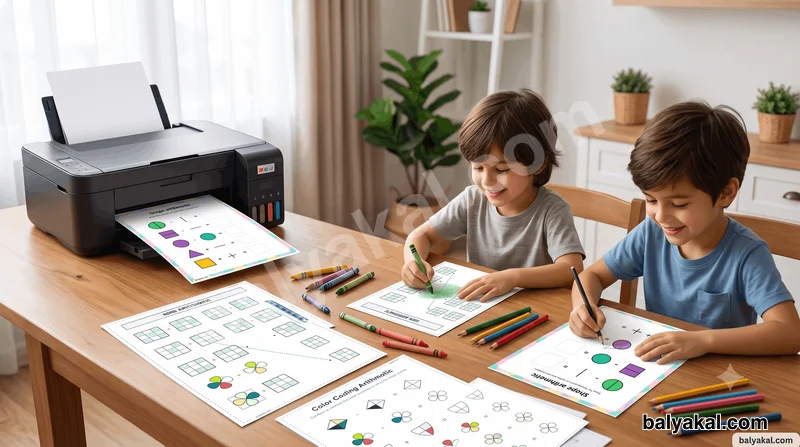
Have you ever noticed how a simple box of crayons can keep a child busy for hours? Kids are naturally drawn to bright, vibrant colors. But what if we used that natural love for color to teach math?
Transitioning from simple color matching to arithmetic is one of the absolute best ways to help kids understand math. Here is a deep dive into the science of visual math, and how using colors actually helps build a smarter, faster-thinking brain.
How Color Coding Builds New Neural Links
When kids look at standard black-and-white numbers on a page, it can feel boring or intimidating. But when we use color coding to teach arithmetic, something amazing happens in the brain.
Associating a specific color with a number or mathematical rule forces the brain to connect visual processing with logical thinking. This dual-action creates strong, new neural pathways. With these new neural links established, children can easily integrate different forms of intelligence.
This makes it much easier for young brains to move from concrete, physical ideas (like counting colorful blocks) to highly abstract math concepts (like algebra and formulas). Simply put, if a child knows a red square means "10", their brain will recall the math rule faster because the color acts as a powerful mental shortcut.
The Magic of "Subitizing"
Another huge benefit of colorful, visual arithmetic is a cognitive skill called "subitizing". Subitizing is the ability to look at a small group of objects and instantly know exactly how many there are without having to count them one by one. Think about rolling a die and instantly knowing you rolled a "four".
Studies show that children who practice subitizing develop much stronger mental math, calculation fluency, and arithmetic skills as they grow. Grouping numbers visually with colored dots trains the brain to recognize patterns and organize visual information efficiently.
Other Benefits of Visual Arithmetic
- Better Focus and Engagement: Colorful math worksheets grab a child's attention and keep them happily engaged much longer than dull, traditional textbook pages.
- Pre-Algebra Readiness: Swapping numbers out for colored shapes teaches children how variable substitution works (e.g., Shape = Value) long before they reach middle school.
- Reduced Math Anxiety: Visual math removes language barriers and heavy text instructions. It makes arithmetic feel like a fun decoding puzzle instead of a stressful test.
Free Printable Worksheets to Try at Home
Ready to put this science into practice? Here at Balyakal, we have created 100% free, print-ready math worksheets that use colors, shapes, and patterns to make arithmetic fun. Try these out with your kids:
- Color Count Arithmetic Help your child master "subitizing" and basic operations! Kids count colored dots inside visual frames to solve equations. You can even print hollow outlines so they can color the dots themselves.
- Color Coding Arithmetic: Turn math into a fun decoding game. This worksheet gives kids a color-coded legend at the top. They must match the colors to numerical values to solve the addition and subtraction puzzles below.
- Shape Arithmetic: A fantastic early introduction to algebra. This tool replaces abstract numbers with geometric shapes. Kids have to figure out the mathematical value of each shape to balance the visual equation.
- Grid Arithmetic: This is a completely non-verbal, spatial math puzzle. Instead of written numbers, kids add or subtract by shading in matrix cells. It is incredible for building spatial mental mapping and logical reasoning!
Skip the boring textbooks and try using colors to teach arithmetic today. It will spark joy and give your child the tools they need to succeed!
Research & References:
- Color Coding Your Math Classroom — Teaching in Room 5
- The Power of Color — Wheaton Montessori School
- What Is Subitizing and How It Builds Math Skills — Mathnasium
- Study on Subitizing: Exploring Numeracy Mastery in Early Childhood — ResearchGate
Explore Related Posts
Discover science-backed parenting tips, child development insights, and fun learning activities on Balyakal.