How to Teach Nepali Alphabet (Barnamala): Classroom & Home Activity Guide
Editorial Integrity & Science-Backed Review
Written by the Balyakal Editor, this guide is based entirely on published early childhood development research, without personal opinions. Every tip and fact comes directly from scientific studies, simplified to help you easily use these strategies.
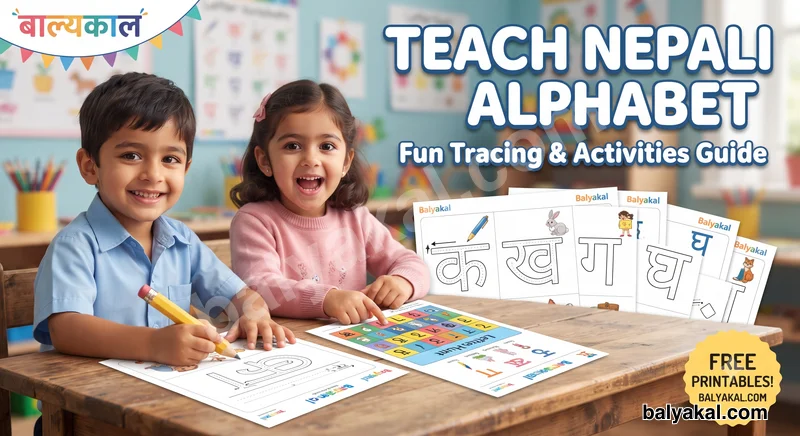
How to Teach Nepali Alphabet (Barnamala): Classroom & Home Activity Guide
A 4-step research-backed framework using 6 free printable worksheet generators for early childhood educators and parents.
Teaching young children Devanagari script presents unique cognitive and motor challenges. Unlike Latin script, Devanagari relies on top horizontal anchor lines (शिरोरेखा / Shirorekha), curved loops, and subtle shape distinctions (e.g., distinguishing ब from व, or घ from ध).
Whether you are a primary teacher managing an LKG/UKG classroom or a parent reinforcing learning at home, physical pen-and-paper writing remains irreplaceable. Neuroscientific research on early handwriting (James & Engelhardt, 2012) demonstrates that tactile tracing and writing activate the brain's reading network significantly more than screen swiping or passive viewing.
Using the printable tools from the Balyakal Barnamala Practice Hub, here is a 4-step framework designed for both classroom instruction and home practice.
Step 1: Master Stroke Mechanics with Guided Tracing
Before children can write independently, they must learn correct stroke flow. A common error among early writers is drawing the horizontal Shirorekha line first instead of last—a habit best corrected through structured tracing.
- In the Classroom: Teachers can print a uniform set for morning warm-up work. Adding your school name, date, and grade header right on the generator gives students a formal daily practice routine.
- At Home: Parents can adjust the grid size and line thickness so younger toddlers start with large arm movements before moving to tight finger grips.
🖨️ Print Worksheet: Generate custom sets with school headers using the Nepali Barnamala Tracing Tool.
Step 2: Build Visual Discrimination with Letter Hunts & Grids
Devanagari characters share structural similarities that frequently confuse young learners. Visual discrimination—the ability to identify subtle differences in shapes—is a prerequisite for fluent reading.
- Letter Hunt: Children scan a grid and circle a target character (e.g., क) hidden among distractor letters. Perfect for quiet desk work or timed speed challenges in class.
- Random Character Grid: A randomized letter matrix used by teachers for quick phonics assessment and by parents for daily reading drills.
🖨️ Print Worksheets: Launch the Nepali Letter Hunt Generator or create a custom reading grid on the Balyakal Barnamala Hub.
Step 3: Trigger Active Recall with Missing Letters & Barakhari
Passive copying builds muscle memory, but active retrieval (testing memory without prompts) cements long-term retention. Once students recognize individual characters, transition to sequence completion exercises:
- Missing Nepali Consonants: Tests sequential knowledge by leaving gaps in the alphabet order (क _ ग _ ङ).
- Missing Nepali Barakhari: Applies the same gap-filling logic to vowel-consonant combinations (क, का, कि, की...).
Classroom Efficiency Tip: Because Balyakal generates infinite random variations, teachers can print 30 unique versions of the same worksheet in one click—preventing students from simply copying off their neighbors.
🖨️ Print Worksheets: Create multi-version classroom tests using the Missing in Sequence Generator—select Nepali Consonants or Nepali Barakhari from the configuration menu.
Step 4: Gamify Learning with Barnamala Maze Escapes
Combining spatial reasoning with language practice keeps children engaged when standard drills become repetitive. In a Barnamala Maze, students navigate from start to finish by drawing a line through the correct alphabetical order of Nepali consonants.
- For Teachers: Ideal as an instant activity for fast-finishers or surprise leisure periods when you need engaging classroom management tools in under 60 seconds.
- For Parents: A great weekend paper game that replaces digital screen time with productive problem-solving.
🖨️ Print Worksheet: Generate instant paper puzzles using the Barnamala Maze Generator.
Why Educators & Parents Choose Balyakal
- Classroom-Ready Customization: Add your school name, student name field, date, and grade directly onto the generated PDF.
- Infinite Replayability: Never run out of practice material. Generate new variations with fresh character arrangements in seconds.
- Zero Subscription Barriers: Core tools are completely free, requiring no mandatory account sign-ups or software downloads.
Complete Barnamala Resource Overview
- Barnamala Tracing
- Core Skill Trained: Fine Motor & Stroke Flow
- Recommended Level: Nursery / LKG / Home
- Direct Tool Link: Open Tracing Tool
- Core Skill Trained: Visual Discrimination
- Recommended Level: LKG / UKG / Home
- Direct Tool Link: Open Letter Hunt
- Core Skill Trained: Speed Scanning & Phonics
- Recommended Level: LKG / UKG / Class Drill
- Direct Tool Link: Open Grid Generator
- Core Skill Trained: Sequential Active Recall
- Recommended Level: UKG / Grade 1 / Test
- Direct Tool Link: Open Sequence Tool
- Core Skill Trained: Vowel-Consonant Synthesis
- Recommended Level: Grade 1 / Grade 2
- Direct Tool Link: Open Barakhari Sequence
- Core Skill Trained: Spatial Logic & Alphabet Order
- Recommended Level: UKG / Primary / Activity
- Direct Tool Link: Open Maze Generator
Explore Related Parenting & Learning Guides
Discover science-backed parenting tips, child development insights, and fun learning activities on Balyakal.