The Cognitive Science of Color Matching: Beyond Simple Recognition
Editorial Integrity & Science-Backed Review
Written by the Balyakal Editor, this guide is based entirely on published early childhood development research, without personal opinions. Every tip and fact comes directly from scientific studies, simplified to help you easily use these strategies.
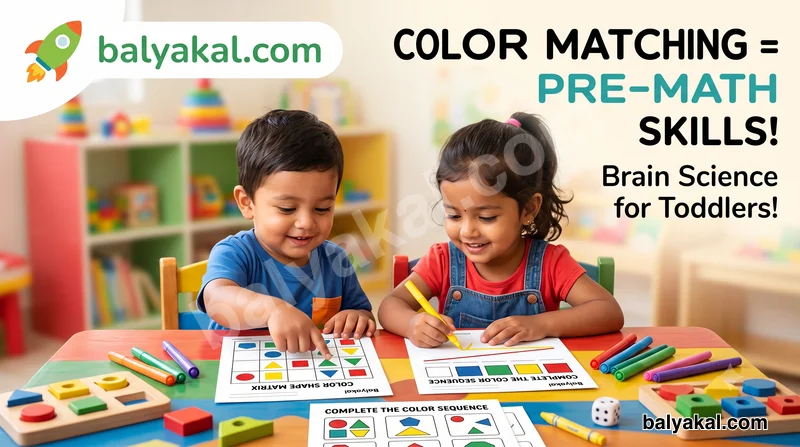
When we think about teaching colors to a 3-year-old, most of us picture simple fun: pointing at an apple and saying "red," or drawing a blue sky. But as parents and educators in Nepal, we often don't realize that color matching is actually one of the earliest cognitive building blocks for mathematics and logical thinking.
It is not just art practice. It is pre-math and pre-coding.
When a child sits down with a structured color-matching activity, their brain is doing heavy lifting. Here is what cognitive science and early childhood research tell us about why color sorting matters, and how specific printable tools prepare young minds for future academic success.
The Brain Science: Color Sorting as Executive Function
Between ages 2 and 4, a child’s brain undergoes rapid neural expansion. During this window, activities that require sorting, sequencing, and matching directly target two core components of Executive Function (EF):
- Working Memory: The ability to hold information in mind while completing a task (e.g., "The key says red equals 1, green equals 2").
- Cognitive Flexibility: The ability to switch focus between rules (e.g., switching from sorting by shape to sorting by color).
When toddlers sort objects by hue, they are performing visual classification. According to developmental psychology frameworks, visual classification forces the brain to isolate specific attributes while ignoring irrelevant noise.
An orange ball and an orange carrot look completely different in physical form, but when a child groups them together under "orange," they learn abstract categorization—the foundation of logical reasoning.
What the Data Says: Connecting Colors to Math Readiness
The connection between early visual sorting and formal schooling is backed by regional and global research.
Key Research Finding:
According to UNICEF’s Early Childhood Development (ECD) framework for South Asia, structured visual pattern recognition activities at age 3 increase early numeracy readiness by up to 30% before formal primary schooling begins.
Why does this happen? Early mathematics is not about writing numbers or memorizing times tables. It is about pattern recognition:
- Algebraic Thinking: Recognizing a sequence like Red -> Blue -> Red -> Blue is the raw form of pattern prediction (A -> B -> A -> B).
- Set Theory: Grouping all green items together is the first step toward understanding mathematical sets and quantities.
- Algorithmic Logic: Following a visual color legend to solve a grid is functionally identical to following an algorithm in computer programming.
The Learning Curve: How Balyakal Tools Build Pre-Math Skills
At Balyakal, we design our printable worksheets to bridge the gap between simple art and active logical thinking. Our collection of color tools guides children through four distinct cognitive learning stages:
Stage 1: Basic Identification & Motor Control
These foundational tools help young toddlers recognize primary colors while building the pincer grip needed for pencil control:
- Coloring Balloons: A classic starting point that builds color association and visual focus without overwhelming the child.
- Flowers Color Match: Combines visual matching with targeted line drawing, building hand-eye coordination.
Stage 2: Spatial Matching & Directional Line Drawing
Moving beyond single items, these worksheets train spatial planning across the page:
- Connect the Matching Colors (Color Join): Challenges kids to cross paths carefully to connect matching pairs.
- Central Color Join Game: Features a central hub with outer nodes, teaching radial scanning and spatial orientation.
Stage 3: Sequential Logic & Pattern Prediction
These activities directly build early algebraic prediction skills:
- Complete the Color Sequence: Requires children to decode visual patterns and accurately predict the missing color in a sequence.
- Color Dot Pattern Match: Tests working memory by asking kids to replicate complete dot-grid matrix patterns.
Stage 4: Matrix Rules, Spatial Observation & Early Math
Our most advanced visual logic tools prepare children for primary school problem solving:
- Color Shape Matrix: Forces children to evaluate two variables at once (rows = shapes, columns = colors).
- Color Coding Arithmetic: Uses color keys as numerical substitutes, bridging visual logic directly into basic addition and subtraction.
- Color Cross: Introduces grid-based coordinate mapping and visual intersections.
- Color the Corners (Square Corner Color): Trains micro-observation by requiring kids to identify specific geometry corners before applying color rules.
- Posture Color: Teaches fine visual discrimination by matching stick-figure body angles and postures to specific colors.
- Color & Dice / Learn to Count Dice Faces: Connects color recognition with subitizing (instantly recognizing numbers on a dice face without counting individual dots).
Why Dynamic Worksheet Generation Matters
Because Balyakal automatically randomizes worksheet layouts every time you generate a printable, your child never simply memorizes answer locations. Every single page provides a brand-new visual puzzle, ensuring genuine cognitive processing every time they sit down to learn.
Simple Daily Tip for Parents
You don't need complicated setups to build these foundational skills. Print out a worksheet from Balyakal, sit with your child for 10–15 minutes, and ask open-ended questions like:
- "Why does this color go in this position?"
- "What rule are we following for this row?"
By shifting the conversation from "What color is this?" to "Why does this color fit here?", you turn a simple activity into a powerful brain-gym workout.
References
- Butterworth, B. (2005). The development of arithmetical abilities. Journal of Child Psychology and Psychiatry, 46(1), 3–18. https://doi.org/10.1111/j.1469-7610.2004.00374.x
- Clements, D. H., & Sarama, J. (2014). Learning and teaching early math: The learning trajectories approach (2nd ed.). Routledge.
- Miyake, A., Friedman, N. P., Emerson, M. J., Witzki, A. H., Howerter, A., & Wager, T. D. (2000). The unity and diversity of executive functions and their contributions to complex "frontal lobe" tasks: A latent variable analysis. Cognitive Psychology, 41(1), 49–100. https://doi.org/10.1006/cogp.1999.0734
- UNESCO. (2007). EFA global monitoring report 2007: Strong foundations - Early childhood care and education. United Nations Educational, Scientific and Cultural Organization.
- UNICEF Regional Office for South Asia. (2018). Early learning and development standards (ELDS) for children aged 0–8 years in South Asia. United Nations Children's Fund.
- Zentall, S. R., & Morris, B. J. (2010). A cognitive model of patterning skills in young children. Journal of Cognition and Development, 11(2), 210–228. https://doi.org/10.1080/15248371003699969
Explore Related Parenting & Learning Guides
Discover science-backed parenting tips, child development insights, and fun learning activities on Balyakal.